


Welcome to the first Practitioner Digest. In today’s edition:
Why you need an anti-bio and how to write one
A collection of Substack notes worth reading
A highlight from the fellowship I lead
An invitation to join me and artist, Michael Mirza, LIVE
I haven’t read your bio but I bet it tells me how magnificent you are!
A paragraph of raw proof: why you’re better, smarter, and more successful than the person reading it.
And like any podium, it isolates you by design.
Trouble is you’re both the person on stage and the person blinding you with the spotlight at the same time. Try as you might to look out at your audience, you just can’t quite duck out of the light of your own brilliance.
It’s not your fault. We’ve been conditioned throughout our lives to lean on our expertise, our wins, and the success that make us worth hearing. But expertise is everywhere. Make it your reason to be worth hearing and you’re about as interesting as the next person in the search result.
You are magnificent, but not for the reasons you think. And not for the reasons you painstakingly highlight in your CV.
So what should we write instead? Your anti-bio.
Here’s mine:
After five redundancies and years on a financial knife-edge, I know how easy it is for fear and urgency to keep us on the content treadmill. Yet everywhere I look, independent operators are slowly killing their businesses trying to get seen. They think they have a visibility problem, but content is not the same as contact. So I work alongside them to ruthlessly strip away the brand theatre, find what makes them unique, and challenge them to actually use it.
It’s a bio. But not as we know it. And that’s the point.
Against a backdrop of beige business-speak and flashy guru attention-grabs, only the scar tissue of your story will make you stand out.
You immediately stop being someone to assess and become someone who sees: useful, grounded, and ready to stand shoulder to shoulder with the person in front of you.
And it’s not something you set and forget. It’s a living workbench, a micro-manifesto. The thing you start from, return to, and use to filter what you do on any given day. If what you’re doing doesn’t honour it, stop doing it.
It can also give rise to other things you need. A job title, for example. I use two: Unremarkable Founder and Anti-brand Strategist.
Let me give you the ingredients so you can write yours.
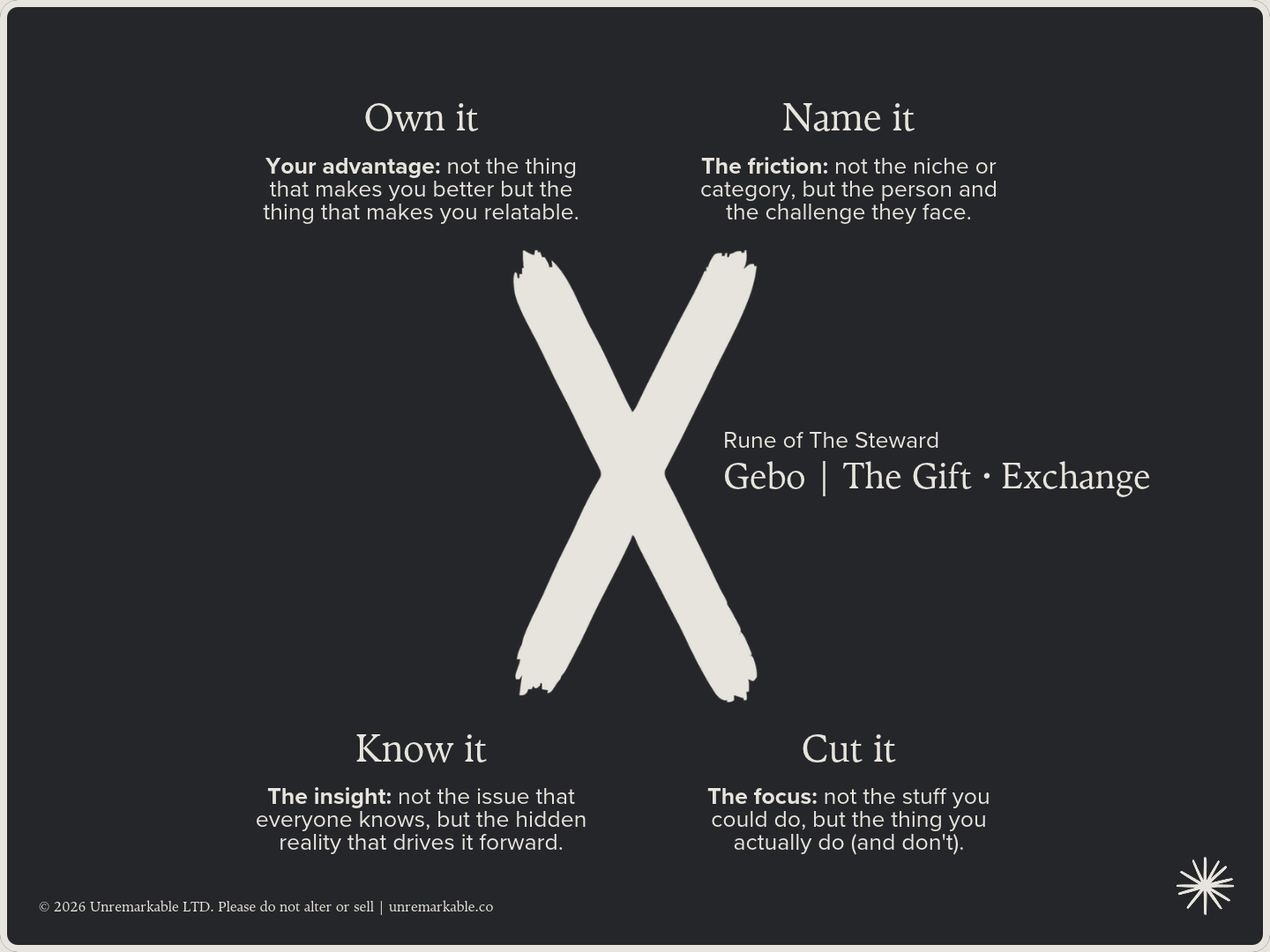
1. Own it
Your advantage: not the thing that makes you better but the thing that makes you relatable.
People do not connect with a perfect track record. They connect with a shared reality. The scars you bear are your ultimate differentiator. They prove you have survived the storm you’re offering to help them through.
Answer this question: What is the messy, unglamorous truth about your background that actually makes you worth listening to?
What I wrote:
After five redundancies and years on a financial knife-edge, I know how easy it is for fear and urgency to keep us on the content treadmill.
2. Name it
The friction: not the niche or category, but the person and the challenge they face.
Forget the demographics, the industry, or the target market. Write for one specific human being. If your words can describe what they feel, you won’t have to pitch. You simply become the inevitable choice for the people already looking for you.
Answer this question: Stop looking at the category. Look at the person. What is the exact weight they are carrying at their desk on any given day?
What I wrote:
Yet everywhere I look, independent operators are slowly killing their businesses trying to get seen.
3. Know it
The insight: not the issue that everyone knows, but the hidden reality that drives it forward.
Whilst everyone else is trying to dominate a niche, you reach deeper. A niche tells people what you sell. An insight tells them what you see. You’ll sound different when you can name the hidden, human truth underneath the problem everyone is actually trying to soothe.
Answer this question: What is the uncomfortable, hidden truth about their situation that the surface-sellers haven’t understood?
What I wrote:
They think they have a visibility problem, but content is not the same as contact.
4. Cut it
The focus: not the stuff you could do, but the thing you actually do (and don’t).
Nobody needs you to do more, be in more places, or create more stuff. They need you to be precise, which is good for you, and essential for them. Draw a perimeter so everyone’s clear about how you serve and what you refuse.
Answer this question: Strip away the philosophical fluff. What is the actual work you’ll do with them, and what boundary will you not cross?
What I wrote:
So I work alongside them to ruthlessly strip away the brand theatre, find what makes them unique, and challenge them to actually use it.
Now it’s over to you. After you’ve read through the notes below and had a look at my invitation, go ahead and grab a piece of paper and a pen and get writing.
See if you can pull your answers together into a single, un-hyped introduction. Something you can use on your website, in a direct message, or when someone asks the inevitable question: “So, what do you do?”
It might feel clunky at first. Mine did too. Our brains aren’t used to thinking like this, and our conditioning about ‘how to do business’ will likely kick in. So write down some ideas, let them rest, then come back. Serve the work and don’t worry about the outcome. It’ll become clear when it’s ready.
To help, start by filling the blanks:
Own it (advantage): The scars that taught me the most are ____________________
Name it (friction): The trap my people are stuck in is ____________________
Know it (insight): The hidden truth nobody is naming is ____________________
Cut it (focus): The work we do (and don’t do) together is ____________________
I’d love to read your anti-bio, please go ahead and send it to me at dan@unremarkable.co
Notes worth reading
Every week I look for Unremarkable creators. People serving the work, not the outcome. Challenging us to feel, act, and serve differently.
Full disclosure, I usually don’t know the author, but I encourage you to click through to their profile, have a look around, and see if you would like to follow their work.
Why I chose it:
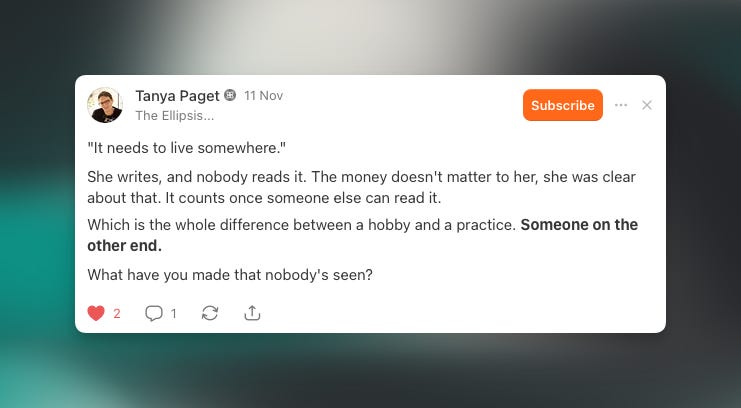
I often talk about closing the circuit, something that content doesn’t do. We literally have to reach out directly and say ‘I wrote this for you’. And yes, we need to do it over and over and over without expectation of a response.
People are so exhausted that your job is to be there for them all the time, that’s the only way you can be sure you’re also there for them at the right time.
➡ Explore Tanya Paget’s work.
Why I chose it:
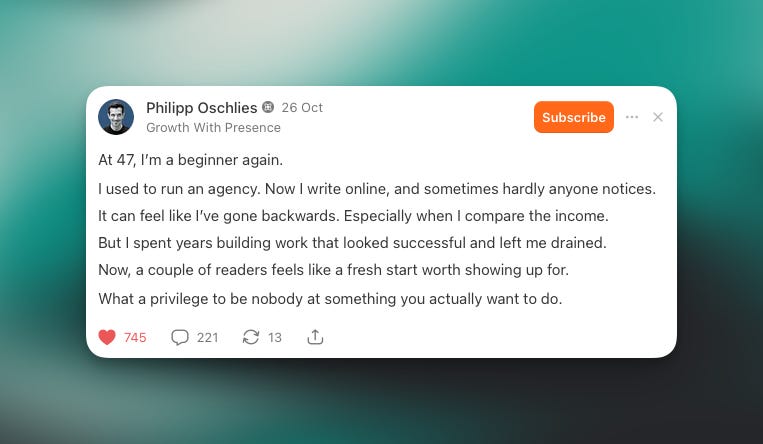
My writing circles one idea: serve the work, not the outcome. As soon as we take aim at the results we send a shockwave through our practice that compromises every action we take.
But starting with who you are, and touching a few people with it? Now that changes everything.
➡ Explore Philipp Oschlies‘ work
Why I chose it:
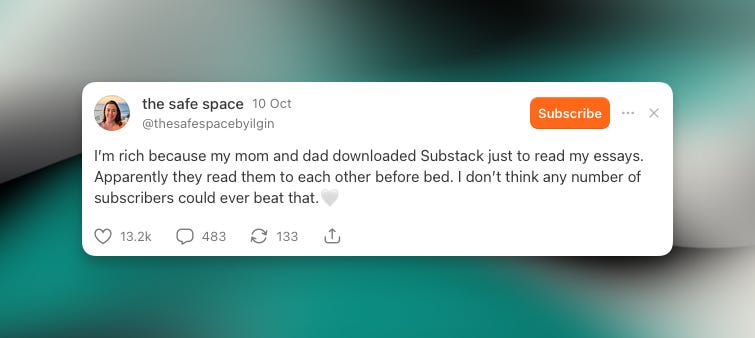
Because it brought a little joy to my heart.
I mostly don’t hear from my 900 subscribers, but my Dad, I can usually bank on some encouragement from him.
So yeah, I could probably squeeze something wise in here, but instead I’ll just say ‘thanks Dad’.
➡ Explore work by the safe space.
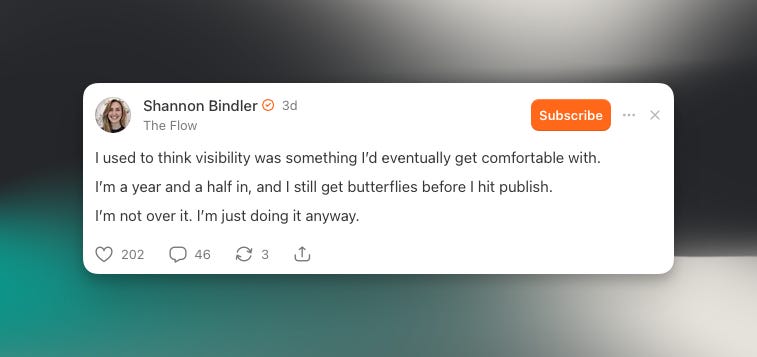
Why I chose it:
Recently I’ve been writing about Rightness (something to say), Howness (how to say it), and Wholeness (speaking from who you are).
Makers need all three and the nerves we sometimes feel when we speak are a signal that you haven’t traded in who you are for an outcome. We feel the weight of what matters and hope that it’s received by the people who need to hear it.
➡ Explore Shannon Bindler’s work.
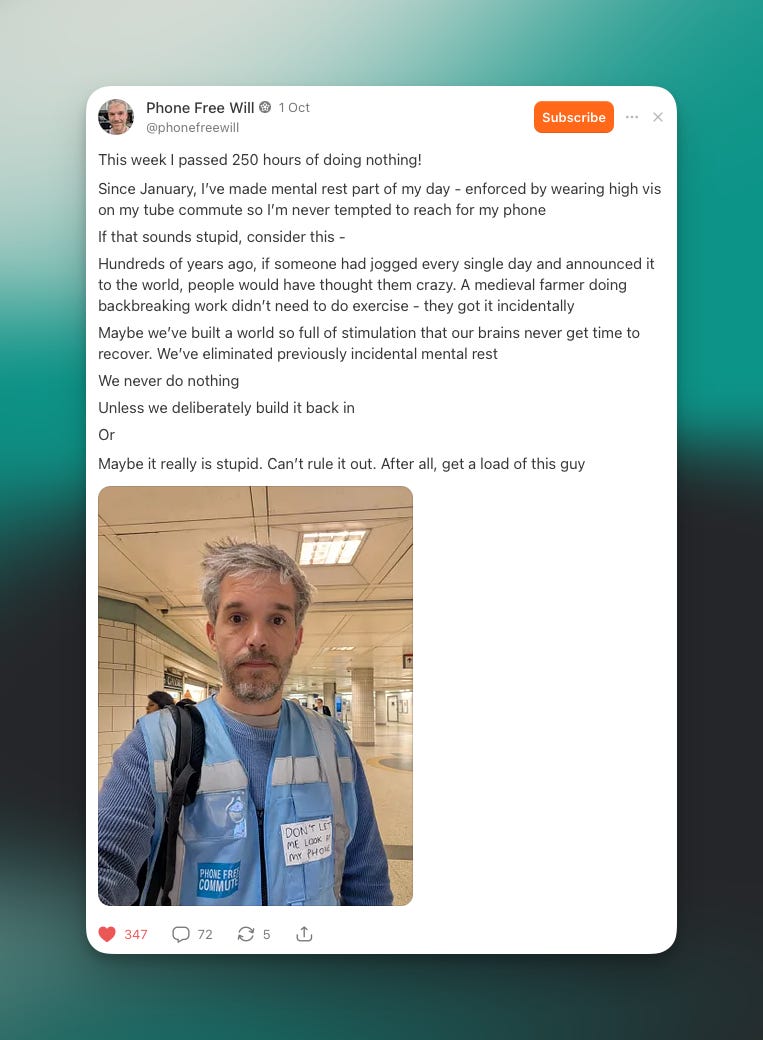
Why I chose it:
I remember taking a walk with my wife and talking about the busyness of it all. As we chatted we landed on an idea: if you’ve planned to do nothing, THAT IS WHAT YOU’VE PLANNED TO DO.
Also, it reminds me of the PEACE Practice, a set of frequencies we need to dial up and down as needed. A is for Action, something many of us have a bias for. P is for Presence, something we must create space for. Often not to reach for some inner peace, but to let some inner peace find us!
➡ Explore the work of Phone Free Will.
Fellowship Highlight: Riverbanks, Not Cages
I lead a small fellowship called the Order of Unremarkable Creators. In each Practitioner Digest I’m going to highlight a friction that we’ve recently been experiencing, and offer a direction of travel. Because if we’re feeling it, many of you are too. What follows emerged from our fellowship call.
The Friction:
Saying no feels like shrinking, especially when every platform rewards constant output, endless networking, and frantic responsiveness. Energy sprawls across fifty daily comments, half-revived side projects, and an endless diet of other people’s ideas until nothing carries real force.
The Words:
“Constraints are not a weakness. It’s the banks of the river that give the water its force. Without those buffers, the river flows in a lazy, meandering way. And so constraints is a choice not just to say no to a bunch of stuff, but to amplify our action.”
The Way:
Sprawl is not generosity; it is dilution. Without edges, good intentions turn into shallow puddles that evaporate before they ever move anything. Real constraints are not deprivation, they are direction: choosing what to refuse so the remaining work gathers weight and velocity. Riverbanks do not trap the water; they give it the power to carve its own path.
An Invitation
So, what will make or break your business?
Contact.
It reveals who you really are.
What you’re here to do.
And what your work is actually asking of you.
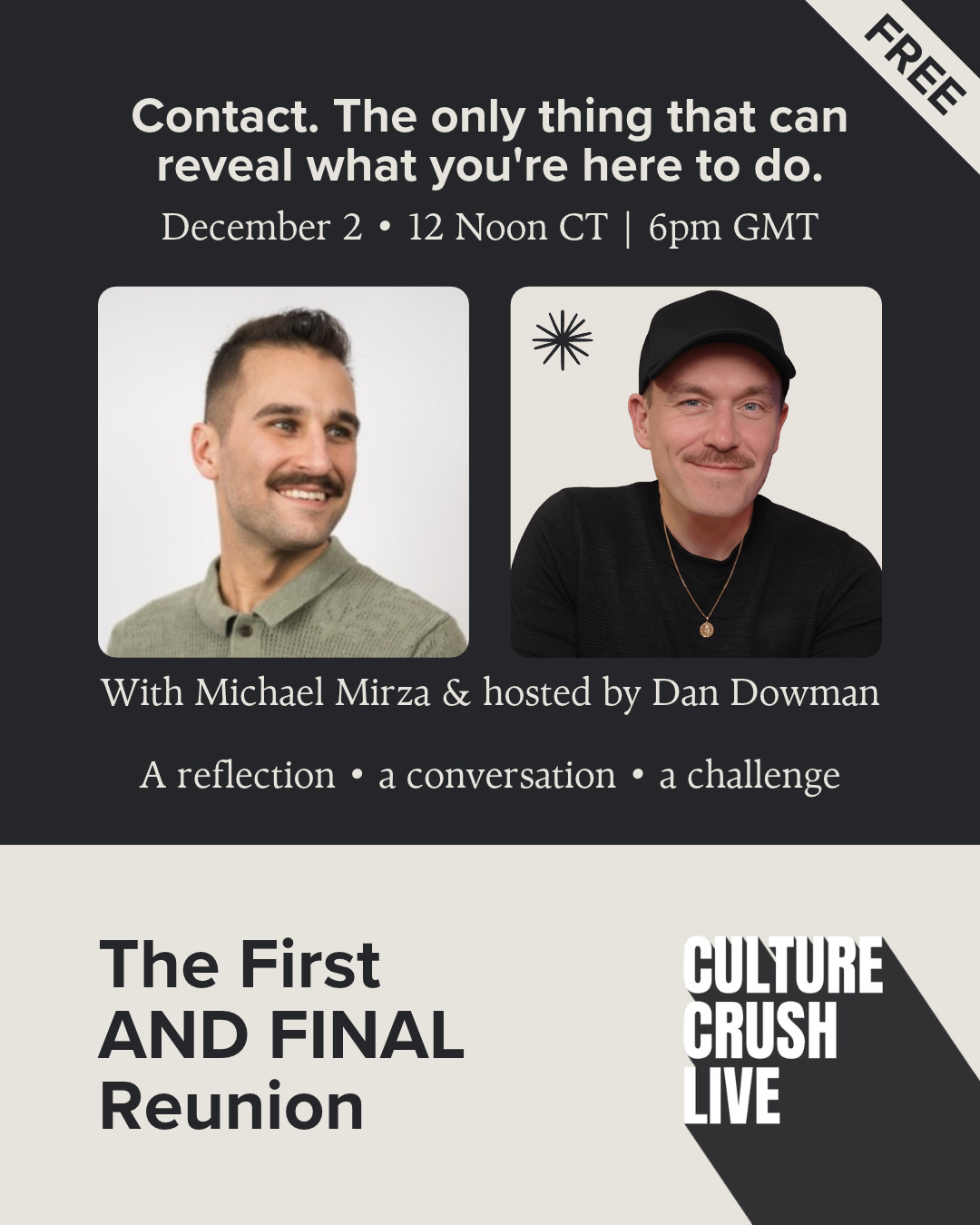
For this first *and final* Culture Crush reunion, Michael Mirza (who recently claimed the calling he’s always felt to be an artist) will be joining me to lead a short reflection before we open the floor for conversation.
No pitches, no replays, no experts telling you what to do. Just good company. Join for the reflection, stay for the conversation, and leave with a challenge.
Register for free here.
And that will do it for the first ever Practitioner Digest. If you’ve made it this far, thank you for sharing this space with me. I’d love to connect with you at the event, but you’re welcome to email me any time (dan@unremarkable.co) or drop me a message here on Substack.
Be well my friends,
Dan Dowman
Unremarkable Founder