


Welcome to this week’s Practitioner Digest. In today’s edition:
Five questions to ask instead of downloading another playbook
A collection of Substack notes worth reading
A highlight from the fellowship I lead
Anti-brand Starter-kit for everyone who attends next week’s free event
Put that email away before you hurt yourself!
I know, I know... The free playbook looks good. Seven hooks that convert. The 30-day content calendar. The DM script that books calls while you sleep. All yours for the small price of your inbox.
And maybe it would help. That’s what makes it so hard to resist!
They’re called lead magnets for a reason.
Here’s what’s really on sale. Not the PDF. The relief. For the ten minutes after you hit download, you feel like you’re moving. The pipeline is bone dry, the algorithm has ignored you again, and here is someone who’s got it all figured out, offering you the outcome you long for in a tidy little bundle, and an impulse price tag.
Here’s the rub: that playbook is just someone else’s answer to a question you might not even be asking.
And it’s why the search for the right solution never ends, because there is no answer out there that can speak to what’s happening within.
Welcome to the Founder’s Noose.
A repeating cycle of fear > action > outcome. Fear drives the actions we take and the outcomes we achieve. We trade our information and download the thing because we’re afraid we’ll miss our chance to make it if we don’t.
That’s the whole business model: name the fear, offer the solution, build the list.
We bury the real friction under a mountain of fear-based actions, and we don’t get what we really long for because we haven’t addressed what we actually need. The fear burns deeper, the action more unhinged, and just around the bend there’s another expert waiting, ready to save you from the despair of another failure with another solution that’s going to fix the problem they’ve decided you have.
And look, I’m not immune.
Just last week I sat down with a lead gen agency. Seriously, I get spammed with this stuff all the time, but my business is on its last financial legs, and in a moment of blind panic, I took the call. Twenty minutes in, they asked who my ideal client was. I gave them a category, they wrote it down, and neither of us ever spoke about an actual person I’ve helped.
If my business is struggling, and your practice feels stuck, it isn’t because we’re not strategic enough. It’s because we’ve traded touch for tactics, contact for content, and service for certainty.
I don’t need to scale anything, I need to message five people so they feel seen, heard and known.
You do too.
It might not immediately add to the bottom line, but it will help you understand the real friction your audience is facing, and help you understand your own.
So next time you feel the pull to download, don’t ask whether the playbook is any good. Ask these five questions about your own work instead. They’ll help you shape an offer, craft a piece of content, or show you what to do with the next hour.
One rule: each question gates the next. If you can’t answer one honestly, don’t move on. Go back a step.
1. Who is this for?
Not the niche. Or a market. Or an ICP. An actual person you know.
If you can’t answer this question, you’ll give your email away all too easily. And no playbook on earth can build on what you don’t have: a real reason to show up.
If you’re not sure: don’t guess. Book some calls with people you know and ask them about a time when you’ve supported them. What helped them feel seen, heard and known? Was there a practical perspective you helped them see? This conversation might just help you recognise the strengths you naturally overlook. A bad habit we all have.
Before we move on: if you start with where you want to be instead of someone to serve, you’ll spend your whole life chasing.
2. What are they longing for?
Not what the guru says they’re asking. Or even what they think they’re asking. What they actually need.
I can ask people what they need, and they can give me an answer. But because what people say they need and what’s driving it are different things, I need the conversation to flow before I can begin to understand what’s really being said.
If you’re not sure: reach out to the person you’ve named, ask them for a call, and ask the question. Don’t just listen to their answers, listen for their words and reactions around their answers.
Before we move on: If there isn’t a natural resonance, there’s probably a gap between what you can offer and who you’re speaking to. Go back to question one.
3. How do I show them I understand?
Not a strategy. Not a steaming pile of scheduled content. A reach across the void.
Plenty of playbooks exist to make this easy. Clever hooks, post formatting, the latest trend. But content is not the same as contact, and your reply to what they need only makes sense when you know who they are and what they’re longing for.
If you’re not sure: test something small. Send a piece of writing, a post, or an offer idea to the person you’re speaking with. Don’t pitch them, ask them what they think and feel about it.
Before we move on: if you make content with meaning, you have to be willing to share it directly with people. Don’t just post it. Send it to one person and say, “I wrote this for you.”
4. What is helping me to do that?
Not side quests. No busy work. Supporting structure and clear decisions.
You’d be forgiven for thinking that I don’t think you need strategy or structure. You do, but at the right time when there’s something for it to actually support. A new funnel, a rebrand, a course on hooks, and a new playbook are all great ways to avoid the first three questions.
And let’s be clear for a moment, this question is the home of all playbooks, and starting here is the thing that destroys most independent operators. Many of us repeatedly start here and then wonder why we’re still stuck. Kinda obvious when you think about it.
If you’re not sure: ask whether the tool you’re using today is putting your reply in someone’s hands. If it’s not, cut it from your world without mercy.
Before we move on: there is of course nuance here. I use Canva to design event invitations, for example. But I need to make a call on when what I’m creating is good AND enough. It doesn’t matter how good it is if no one ever sees it.
5. What actually happened?
Not a verdict. Not a decision. Just information to consider.
Notice what happened: resonance, silence, criticism? None of it is a judgement on your worth or the value of your offer. It’s just information about whether the truth of it is reaching people. This is the question that turns the other four into a practice. It sends you back to the start knowing a little more about who you serve.
If you’re not sure: make contact with anyone who reacted or engaged with your content. Ask the people you’ve reached out to what they thought and how it made them feel.
Before we move on: if you feel disappointed that the reply didn’t land, that’s an important signal. It suggests that you’re still reaching. The deeper friction is that you’re still not yet really grounded in who you’re serving or what they’re really longing for. When you’ve reached a real understanding of those two questions, you’ll gladly sacrifice the perfect prose or piece of content for something clear that actually works.
Your content is a great place to put these five questions into practice. Just don’t judge its value by its reach.
You’re not shooting for views or likes. You’re looking for resonance with the person you named. Unless you have a massive audience, the numbers leave you with two choices: pay to promote your content, or create noise that keeps people scrolling. Both serve the platform, not your practice. The only way to know? Ask.
Now it’s over to you.
Next time you hover over the sign-up button, grab a piece of paper and a pen instead.
Fill the blanks:
The person this is for is called ____________________
What they’re longing for is ____________________
I show them I understand by ____________________
The things that help me do that are ____________________
What happened, and what I’ll try next time, is ____________________
For the sake of transparency, I’m not against downloading stuff. I offer my ideas, run events, and write on Substack because my business needs email addresses too. But I don’t want to build any old list, I don’t want scale for the sake of it, I want to reach people who genuinely need my support and are ready to do something about their calling.
So look, if you reach question four and the playbook still earns its place, brilliant. Download it with my blessing. But just remember: whilst it might help you, it was created to help them.
My hunch is that most of the time you’ll find you didn’t need someone else’s outcome. You needed a clearer view of the person you're here to serve.
Next week I’ll come back to these five questions and show you what’s underneath them. A small clue: it isn't a framework.
For now, put that email away and pick up a pen instead.
Notes worth reading
Every week I look for Unremarkable creators. People serving the work, not the outcome. Challenging us to feel, act, and serve differently.
Full disclosure, I usually don’t know the author, but I encourage you to click through to their profile, have a look around, and see if you would like to follow their work.
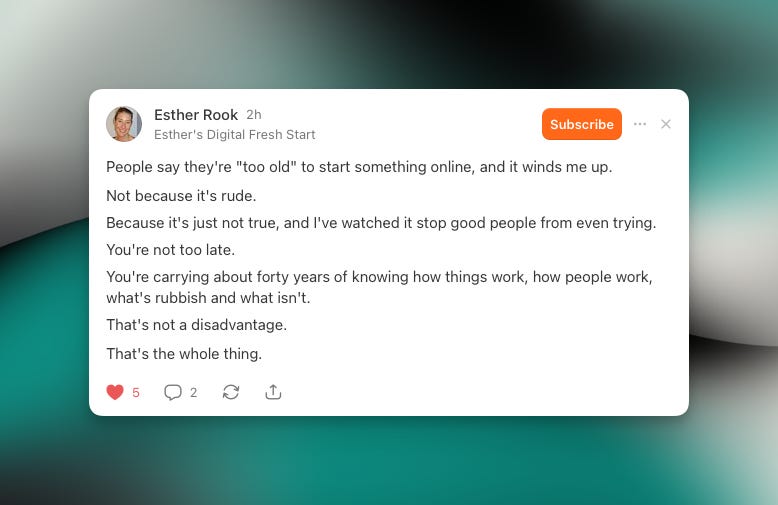
Why I chose it:
Because more people my age need to hear it.
I wrote about it recently too, in I Forgive, Therefore I am:
“Me? I went on to experience five redundancies in a decade and even today, find it hard to shake the feeling that I’m a failure. The one who doesn’t have enough faith, who’s always too late, and now too old.
…
Today, you might feel trapped by the walls of your story, but you haven’t missed it. You’re not too old, too late, or too irrelevant. A calling isn’t a destination you miss, it’s a direction of travel that starts right where you’re standing. It’s found in the rubble of the walls by those who choose to tear them down.”
➡ Explore Esther Rook’s work here.
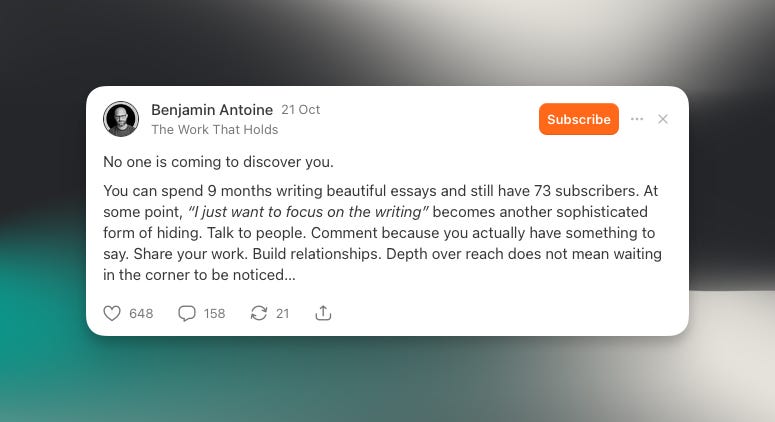
Why I chose it:
I’m like 50K words into a book outlining what people have been asking me for. But in the last chapter I wrote myself into this realisation: content is not the same as contact.
My mission has been noble, and it’s bascially killed my business.
We can’t expect people to pass by and be struck down by the magnificence of our wisdom. People are either too damn tired for that, or out here grazing for more answers which means they bounce off depth.
Write because it’s good for you.
Post because it’s good for them.
Then REACH OUT, and literally put it in their hands.
➡ Explore Benjamin Antoine’s work here.
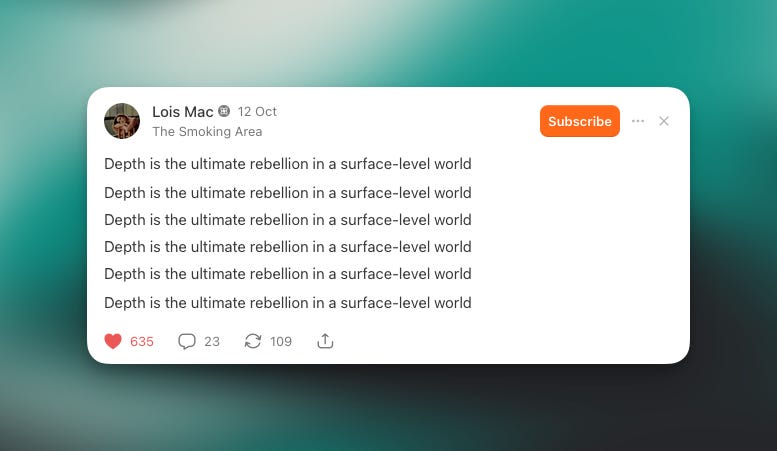
Why I chose it:
The thing all my work circles is simply this: serve the work, not the outcome.
In other words, go deep.
You might not find what you expected or wanted, but you’ll find what you need.
And that will rewrite what you expect and want.
➡ Explore Lois Mac’s work here.
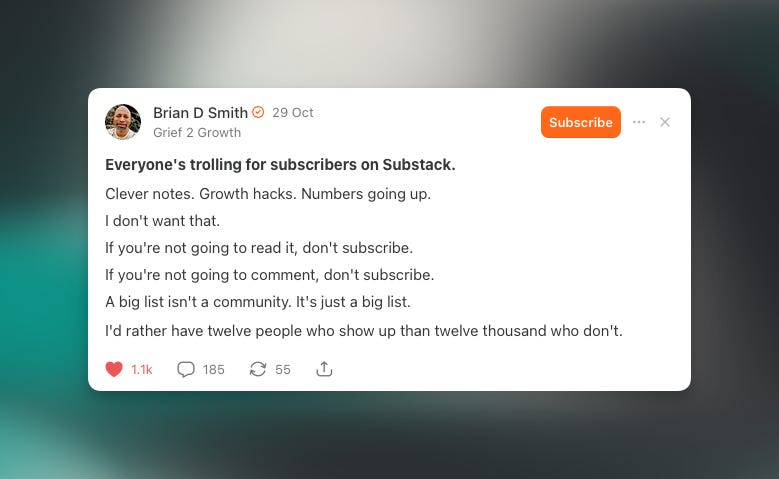
Why I chose it:
One thing I talk about A LOT with my community is what I call the abundance of one.
Contact is the one thing that can change any practice or person, and it’s something no list or broadcast can ever give you.
➡ Explore Brian D Smith’s work here.
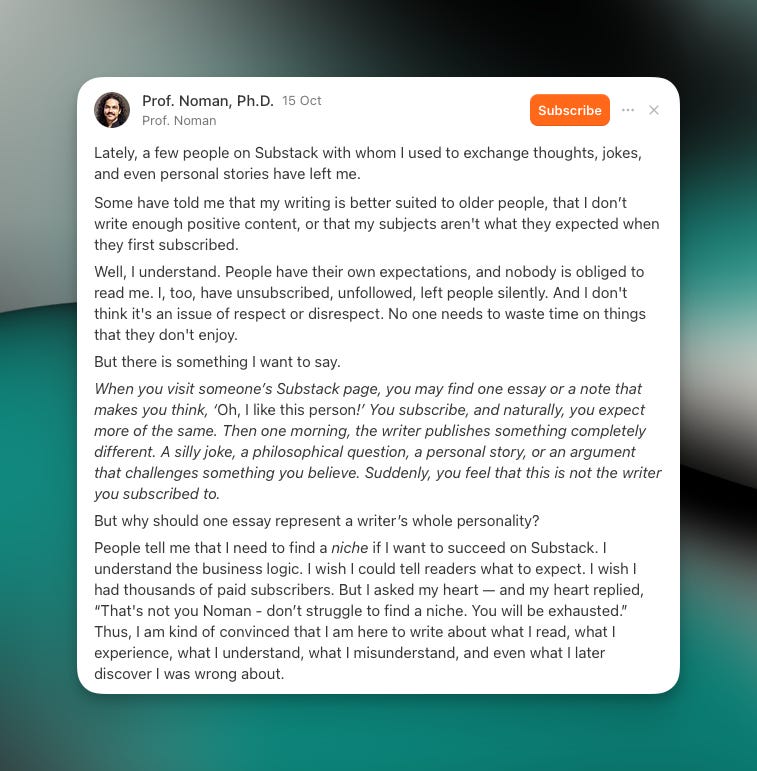
Why I chose it:
Everyone’s going niche. Not because it’s good for them, but because it makes you digestible for the algorithm.
What a dreary way to live.
My work is a god damn bone… the algorithm can choke on it.
I wasn’t able to include Noman’s full note, you can read it here.
➡ Explore Prof. Noman, Ph.D.’s work here.
Fellowship Highlight: Shockwave
I lead a small fellowship called the Order of Unremarkable Creators. In each Practitioner Digest I’m going to highlight a friction that we’ve recently been experiencing, and offer a direction of travel. Because if we’re feeling it, many of you are too. What follows emerged from our fellowship call.
The Friction
Fixating on a predetermined revenue target or viral breakthrough warps daily decision-making. Instead of responding honestly to what the work needs right now, every move becomes a calculated performance engineered to force a result.
The Words
“The moment you go, ‘I need this outcome,’ that sends a shock wave back through everything that you do, because the next step isn’t the next step you need to take, it’s the step you think you should take in order to reach the outcome. And actually, that pollutant coming back, messes you up every time.”
The Way
An outcome is a terrible compass. When a distant target dictates today’s action, intuition is replaced by anxiety and craft is replaced by manipulation. Serving the work means staying close to the immediate reality in front of you: listening, testing, and taking the next faithful step without trying to rig the harvest. What grows from faithfulness lasts; what is forced by panic eventually collapses.
An Invitation
Repeat after me: content is not the same as contact.
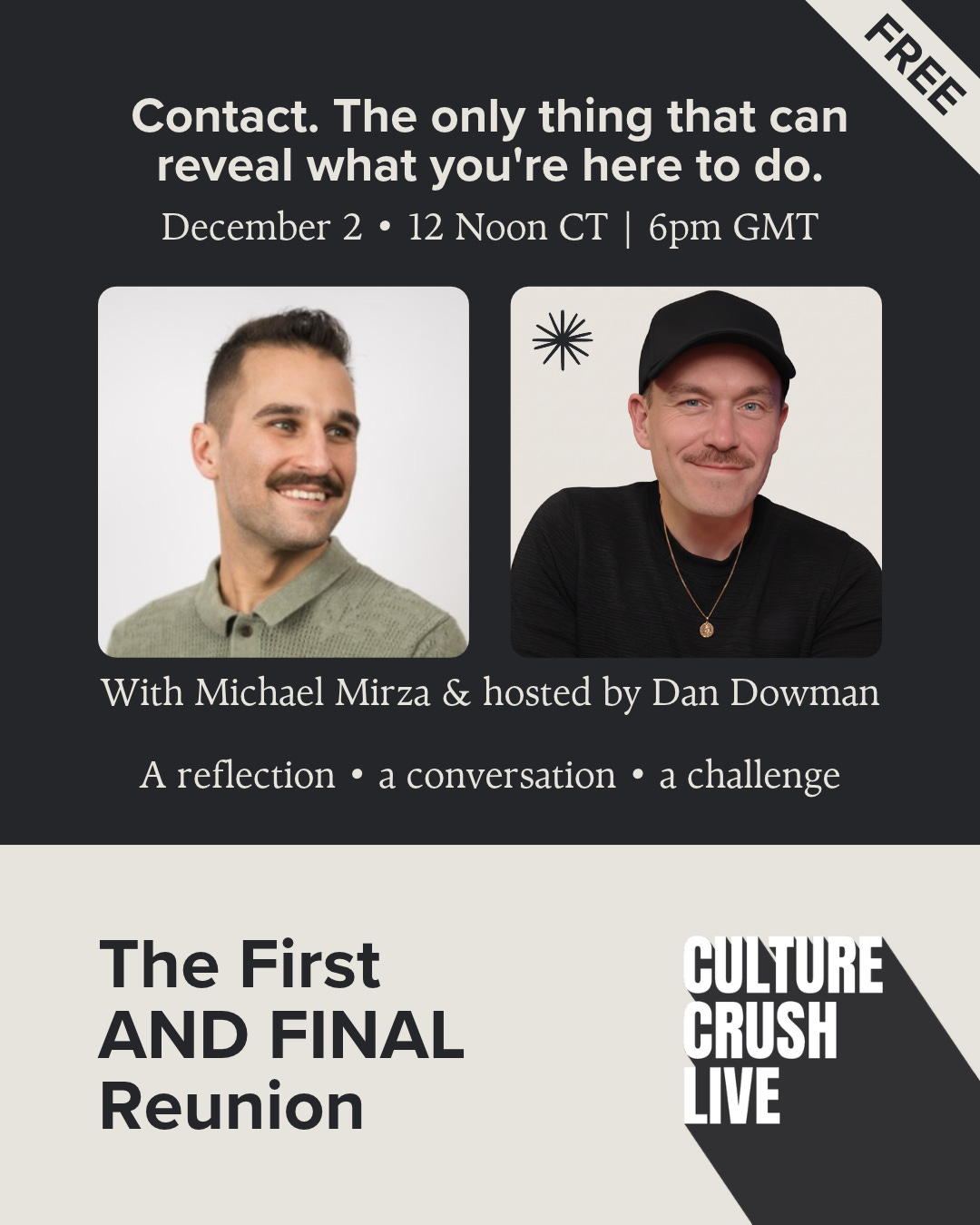
I’m giving everyone who joins The First (AND FINAL) Culture Crush Reunion next week access to the Anti-brand Starter-kit for free.
A set of tools that will help you name your calling clearly, and give you the words you need to make meaningful contact with others.
December 2 • 12 Noon CT | 6pm GMT
Feat. legendary Artist and friend Michael Mirza.
And that will do it for this week’s Practitioner Digest. If you’ve made it this far, thank you for sharing this space with me. You’re welcome to email me any time (dan@unremarkable.co) or drop me a message here on Substack.
Be well my friends,
Dan Dowman
Unremarkable Founder
Great advice.
Thanks for the tag Dan ❤️