


“I’d take a bullet for that man, but he couldn’t work here. He’s too weak.”
“He’s a poor leader, nothing more than a beta-male who believes he’s an alpha.”
“It’s not personal, it’s just business.”
I was sat on the balcony of a small business centre just outside London in the drizzle facing my former friend and co-worker, cigarette bouncing excitedly on the end of her lips, as she ripped into our mutual connections.
People who had stood alongside her, people who’d given her opportunities, long-term friends of us both.
The only problem is that we were working together at an unprofitable micro-agency with brittle leadership on the brink of collapse. What she said would have been completely unnecessary in any context, but the confidence she spoke with sounded like a Bond villain completely adrift from the reality at hand.
I knew I was in trouble. And within a matter of months the business had collapsed.
We’d been a small team awash with gossip, gaslighting, credit-stealing, and all-too-regular sexual objectification of colleagues disguised as charm. It was a nasty business obsessed with outcomes, and willing to accept any behaviour in order to reach them.
It’s a professional archetype we’re all familiar with: the ‘I don’t do BS’ champion shaping their career through sheer force at the expense of everyone else.
And as painful as it is to admit it, they have a cutting edge that we can all learn from. Rightness. An opinion, a voice to use, and a soapbox to stand on. Something that no practitioner can survive without.
But every cutting edge must be used with great care.
The Bureaucrat
“I’ve got another offer on the table for more money, but I really like the team and the projects you’re working on. Is there anything we can do?”
“Dan, we can’t offer you more right now, but we can commit to a salary review after six months instead of a year, and we’ll bring you in line with your current offer. And don’t worry, I know you’ve had promises like this before, but you can trust us…
…We’re like a family here.”
Over the next six months, I worked with global brands, brought in a quarter of a million in sales (despite not working in sales), and used my background as a collaboration practitioner to accelerate consulting deliverables by 67%.
I was excited to talk salary.
What I met was a hard boundary: salary reviews happen annually. Paired with a phrase we’ve all heard: “If we did that for you, we’d have to do it for everyone.”
Though I produced the email trail, their response wasn’t an apology; it was homework. I was tasked with benchmarking my salary against industry norms, and we entered a negotiation that unfolded at a glacial pace. Four months later, one Friday afternoon, I realised the benchmarks were irrelevant and accepted a heavy compromise that still fell short of the offer I had turned down.
Monday morning followed, and a new meeting with the very same manager and HR rep came with it: my role was at risk of redundancy.
By the end of the week, I was unemployed.
The whole experience was just sad. There was no malice. They simply arrived with a decision, a procedure to execute, and a script to read. Like functionaries bound by a corporate liturgy, reciting words they didn’t write to justify a sacrifice they couldn’t prevent.
You’ve met this archetype too: the smiling advocate of “we’re a family here” who disappears behind the filing cabinet the moment the system demands a sacrifice on the altar of the bottom line.
It’s why, unlike my Poundland Bond villain, I’ll cut them some slack. Whilst it was personal for me, it was literally their job to land the blow.
And yet, we cannot survive without what they guard. Every business, every practice, and every creative project needs structure, cadence, fairness, sustainable craft, and a clear path from an idea to reality. Howness is essential.
But it can easily become a place to hide.
The Recluse
The question is whether you’ll stay on the shore or wade in. Because only one of those changes you.
The shore is teeming with authors, entrepreneurs, and marketers. Some are barking coaching tips on how to swim, others are throwing floats, the rest are sitting at their laptops creating a brilliant hook for a social post.
But empathy asks: who are you going to respond to? Only then will you put down the plan and sprint into the water like their life depended on it.
- From Too Close to See It (Movement 2)
My words. Unlived.
This book on that shore.
I’ve had one good year in business thanks to a free series of low-key meetups and a newsletter I used to run called Culture Crush. The idea was simple: it’s lonely out there, so let’s get together for a short reflection and some conversations.
Thousands joined, and from it flowed problems to solve, paid partnerships, and collaborations. And in the endless hours of conversations, live events, and client work, I noticed that people often wanted to know how I was building my business in such a grounded way, how I built an audience that felt like real community, and whether I could help them do the same.
That discovery felt like a revelation and The Unremarkable Entrepreneur was born.
In late 2025, I made a decisive call: I announced the end of Culture Crush so I could focus on writing it. Since then, I’ve published tens of thousands of words. Each crafted to honour that decision and written with great affection for the makers, artists, and practitioners who were asking for it.
And it has driven my practice to breaking point.
What I didn’t understand then, but I do now, is that content is not the same as contact. Any one of these chapters is a poor replacement for offering someone a seat and the chance to talk. The real work was never the distillation of any wisdom, as important as that may be, because my community didn’t want a guidebook.
They wanted a guide.
Someone standing shoulder to shoulder with them so they could see what’s possible when they look again through a different set of eyes. Something that no amount of words to read could ever replicate.
That messy campfire that saved me then is the very thing my practice is missing now.
Yes, the Order of Unremarkable Creators exists, but that fellowship demands a level of intention that many practitioners aren’t ready for. The ones stuck in the flood, drowning in solutions that don’t work, and backed into a corner by the silence of the algorithm.
My contact with them has dropped to near zero.
I am the final archetype. And I would wager that many of you are too.
The practitioner so enthralled by what we believe that we cut it off from the oxygen it needs to burn: contact.
I’ve spent the last year writing from every available wound, hoping to liberate practitioners from the judgment of any metric, bank statement, or broken playbook. Trying to illuminate the foundation that no practice can endure without: Wholeness.
I still believe it. I long to share it. I thought that’s what they needed. But no amount of writing about it will place it in someone else’s hands.
I’ve been busy. And my practice has barely moved an inch.
What we reach for
Three practitioners, three stories of neglect.
My Poundland Bond villain was locked into Rightness. What she didn’t have was the Wholeness to ground it, or Howness to make it useful. It left her proudly standing on a diagnosis devoid of humanity, the arbiter of weakness and incompetence as she saw it, with nothing useful for all that energy to do.
The HR manager was locked into Howness. What she couldn’t access, even if she wanted to, was the Rightness to call out the broken system, or the Wholeness to look me in the eye and admit how it had failed me. It’s just business? That’s just bullshit.
And me? I was locked into Wholeness. What I’ve neglected is the Howness to give it to people, and the Rightness that could have told me to do something about it sooner. Over the last year, I’ve felt the pinch of fear that my practice isn’t moving forward many times, a problem that no amount of words could solve.
Each brutally revealing one part of a complete posture. And each distorted by what it was missing.
Rightness is the edge. Decisive clarity. The refusal to opt in to the fantasy: the organisation hiding behind “it’s just business”, the practitioner faking momentum through busyness, and the bully who mistakes brute force for strength. It is the courage to look squarely at what is broken, protect what matters, and have something to say.
And without Wholeness and Howness, Rightness becomes tyranny. Trying to dominate its way through the world.
Howness is the way. The rhythm, the craft, the deliberate decision to build a bridge between your work and the people it’s meant to serve. It is not just about movement. It’s about paying attention to how you move: rejecting extraction in favour of reciprocity, refusing to let the ends justify the means, and pacing your craft so it neither consumes you nor abandons the people who need you.
And without Rightness and Wholeness, Howness becomes bureaucracy. Trying to filter reality through policy, templates, and procedure.
Wholeness is the root. The ultimate editorial filter of your life and work. Not a feeling, but an active ingredient permeating everything you do. If Wholeness cannot honestly endorse the work, it must be abandoned without exception. Your practice will not survive if you compromise Wholeness to feed an outcome.
And without Howness and Rightness, Wholeness becomes paralysis. Trying to honour what it’s found without ever touching someone with it.
Learning to shift
None of these distortions make a grand entrance, but arrive more like a feeling you’ve learned to ignore.
Rightness feels like moral clarity until you notice no one is following you. Howness feels like diligence but your perfect process won’t pay the bills. Wholeness feels great until you realise the only person you’ve helped is yourself.
None of us can afford to stay locked in one stance. But the solution isn’t to abandon it. It’s to shift your weight.
If you’re stuck in Rightness: find someone to serve instead of something to say.
If you’re stuck in Howness: stop perfecting the system and write down what you really care about.
If you’re stuck in Wholeness: stop contemplating and tell someone what you’ve found.
Rightness, Howness, Wholeness.
They are counterweights to balance: Wholeness keeps Rightness from turning cruel, and Howness gives it somewhere to land. Rightness gives Wholeness a voice, and Howness puts it in people’s hands. Wholeness gives Howness a heartbeat, and Rightness gives it momentum.
None can carry your work alone. And when the storm arrives, they allow you to distribute your weight so you can lean into the wind.
Your practice won’t survive without all three.
And neither will mine.
The very next step
This book has been a massive commitment to sustained action, the very thing this Movement is about. Every page has balanced what I planned to write with what wanted to emerge as I did so.
In reflecting on my brother’s reaction to his diagnosis, speaking with the Order of Unremarkable Creators, and facing the end of my own practice, I began to understand how essential Rightness, Howness, and Wholeness are for all of us.
So I planned this chapter and started to write, but it wasn’t until this very moment that I’ve realised what they demand from me.
And it isn’t more words.
I’m not going to talk about action. I’m going to take it.
Until I’ve added counterweight to my own practice, the writing stops here.
None of us build anything real from the safety of the shore. Sooner or later, we have to recognise the storm, distribute our weight, and step into the weather anyway.
For me, that means stepping away from the manuscript long enough to light the campfire again. Wading into the flood, standing shoulder to shoulder, and helping people see what is possible right where they stand.
Letting real contact do what tens of thousands of words never could.

Practitioner call: I’m not waiting. Neither should you.
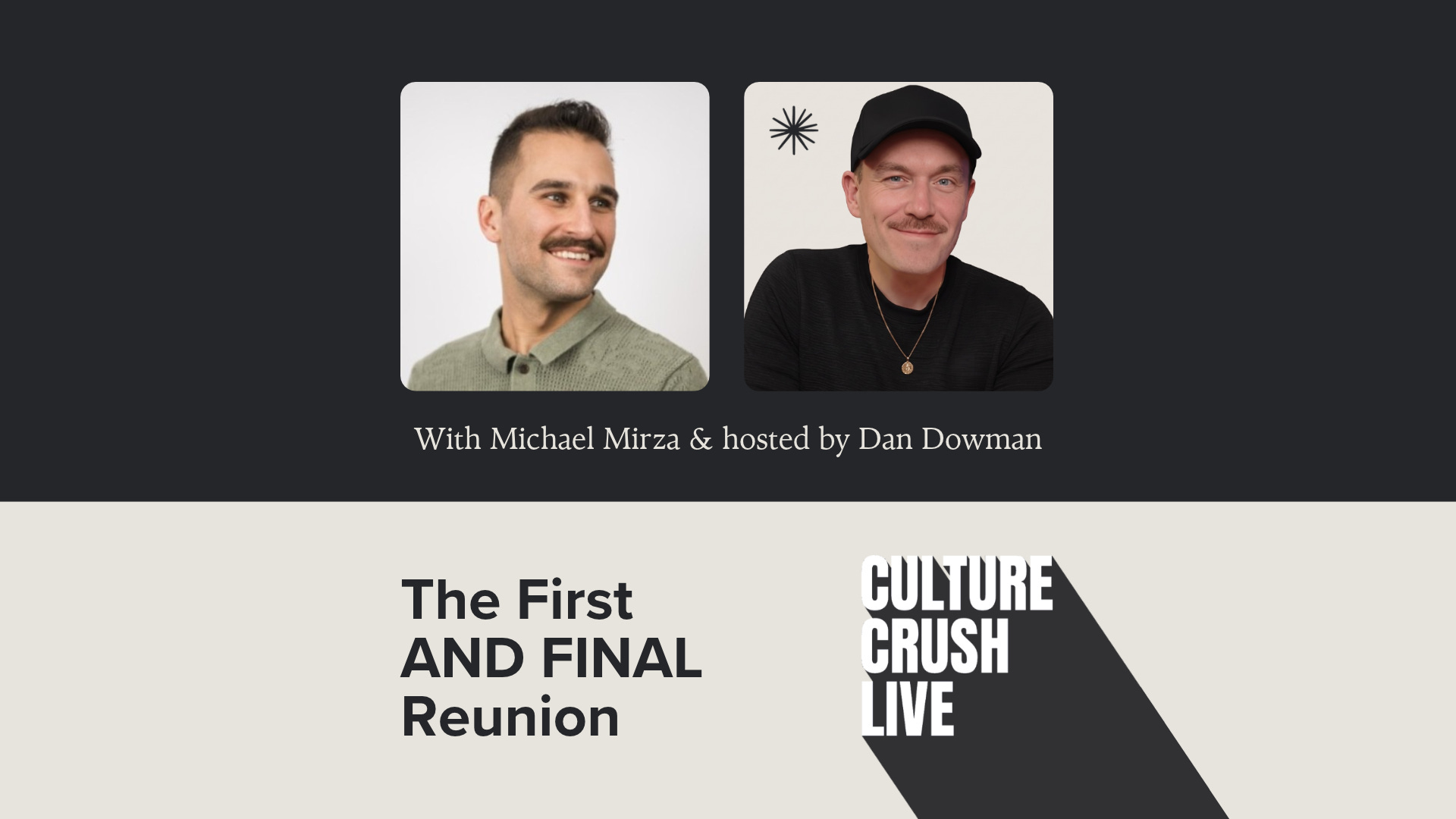
I’m hosting the first AND FINAL Culture Crush reunion on December 2nd.
We’re going to talk about contact: the one thing that can reliably reveal who you are, what you’re here to do, and the one thing my practice has been missing.
Michael Mirza, who has recently reconnected with his own calling as an artist, will be joining me to share a short reflection, followed by some open conversation.
And of course, we’ll also talk about what comes next. Here’s what you need to know:
No replays (to join the convo, join the convo)
Online, December 2nd at 12 Noon CT / 6pm GMT
All welcome from anywhere
FREE (but spots are limited): https://luma.com/05m89mwb
Where We Are:
This is Week 30 of a year-long practice.
Movement 3: Action - eight weeks exploring the architecture of conscious action, how to stand in the weather, and the courage to make contact.
The Distorted Creator ← You are here
Touch the Leper
Present Like an Artist
You Can’t Steer a Ship That Isn’t Moving
Why You’ll Fail
Icon / Action Taker
Please note that publication of The Unremarkable Entrepreneur is taking an indefinite pause for the reasons outlined in this release.